









Singapore karatekas grabbed headlines at the recently concluded SEA Games when debutante Marissa Hafezan took the women’s under-55kg kumite (sparring) title – a first gold in the sport for the Republic since 1993 – while Isaiah Tang took bronze in the men’s under-75kg event.
Compatriot Chua Sheng Da (men’s under-67kg) also narrowly missed out on a podium place, losing in the dying seconds to Manantan John Matthew of the Philippines in the bronze-medal match (2-1), while 2025 IKGA (International Karatedo Gojukai Association) Global Championships winner Dimanya Dewangee fell in the preliminary stages of the under-61kg contest.
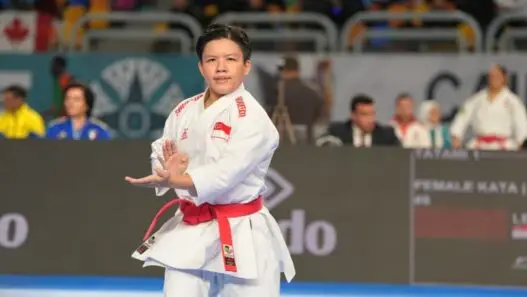
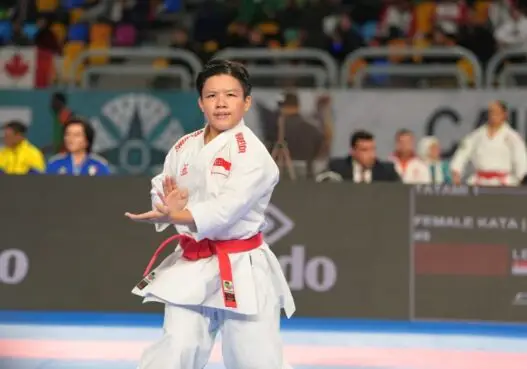
It was a commendable showing by the quartet, but due to the inclusion of only kumite and team kata (form) events at the regional Games, there was a notable omission of Singapore’s 58th-ranked individual kata athlete Shannon Leong, who had recently become the first Singaporean female karate athlete to reach the round of 16 at the WKF (World Karate Federation) World Karate Championships.

The individual kata fighter had to go through a gruelling qualification tournament in Paris, France, in October, where 32 competitors fought to book one of the six coveted spots at the World Championships in Cairo in November. A win against Greece’s world no.16 Georgia-Archontia Xenou 40.30 to 39.00 in the final stage earned her a third appearance at the prestigious championships.
She had previously competed in the 2021 and 2023 editions, where she finished 41st and 29th respectively, but Leong went one step further this time, beating the Czech Republic’s Veronika Miskova (15th) 39.10-37.80 and Canada’s Claudia Laos-Loo (23rd) 38.60-38.50 to make the knockouts, where she was edged by Egypt’s eventual bronze medallist and world number 8 Aya Hesham in 40.20-38.40.
The recent improvements by Singaporean karatekas on the international stage are no coincidence. They reflect rigorous training programs complemented by overseas camps and exchanges, giving athletes exposure to elite coaching and sparring with top-level opponents.
Karate-Do Union of Singapore secretary-general and national team head coach of kata, Leong Fook Weng, who is also Shannon’s father, said, “We always strive to improve because we don’t want to remain stagnant. Training alongside overseas athletes who are former world champions or Olympic medallists pushes us to give our best. Ultimately, we do this to challenge and push ourselves.”
And so, while the kumite athletes were competing at the SEA Games in Thailand, the pair trained at Sakumoto Karate Academy in Okinawa, Japan, under Tsuguo Sakumoto, a seven-time world champion in male individual kata and Japan’s Olympic karate coach.

Leong was put through his paces as well as he participated in the same training meant for the active athletes.
Just ahead of the SEA Games, Chua and Dimanya spent two weeks at the Karev Esat Delihasan National Team Camp Training Centre in Istanbul, Turkey, training under Okay Arpa, a former world and European champion in team kumite. Chua also sparred with Eray Samdan, the reigning world champion in individual kumite, giving them valuable experiences as they prepared for the regional Games.

“We fund this ourselves because we want to raise the standard of karate, not just to be among the best in Southeast Asia, but one day to compete with the best in Asia and the world. I believe we’re definitely moving in the right direction,” Leong said.
Shannon, who also works as a physical trainer and karate coach to support her athletic pursuits, is equally cognisant of the sport’s steady growth in Singapore.
“I think we’ve come a long way since 2020, since we were first accepted into the World Karate Federation (WKF). And we’ve seen progress at the recent SEA Games, we secured one gold and one bronze. I hope we can continue on this path, and I also aim to contribute further to the sport, showing that karate is on the rise.”
And she aims to walk the talk with her sights set on competing in the top-tier Karate1-Premier League, having competed in the second-tier Series A on five previous occasions.
She will be heading to Tbilisi, Georgia, come January for the Series A, with hopes of performing well enough to qualify for the top-tier circuit, where the sport’s best karatekas compete regularly.
“I spoke with my juniors about this, and I’m very proud of what they achieved at the SEA Games. I hope that I can be an inspiration to them someday and I’ll continue to do my best and aim for even higher positions in the future,” Shannon said.
Looking ahead, the future looks bright for Singapore karate, with the junior kumite squad also having recently attended a training camp with Vietnam’s junior team at the Ho Chi Minh City National Sports Training Centre, aimed at nurturing young talent and expanding the pool of athletes capable of joining the 30-member national team.

“Through these exchanges, they can pick up some new skills and get new experiences to improve themselves,” Leong added.
There are also hopes to bring more national team athletes to compete in international competitions like the Series A to help them “get more exposure and see the different styles of fighting”.