








Name: Koh Chen Pin
Age: 33
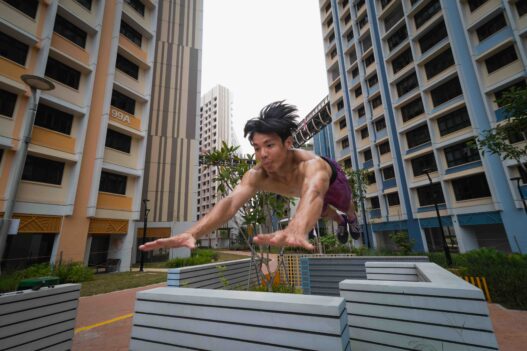
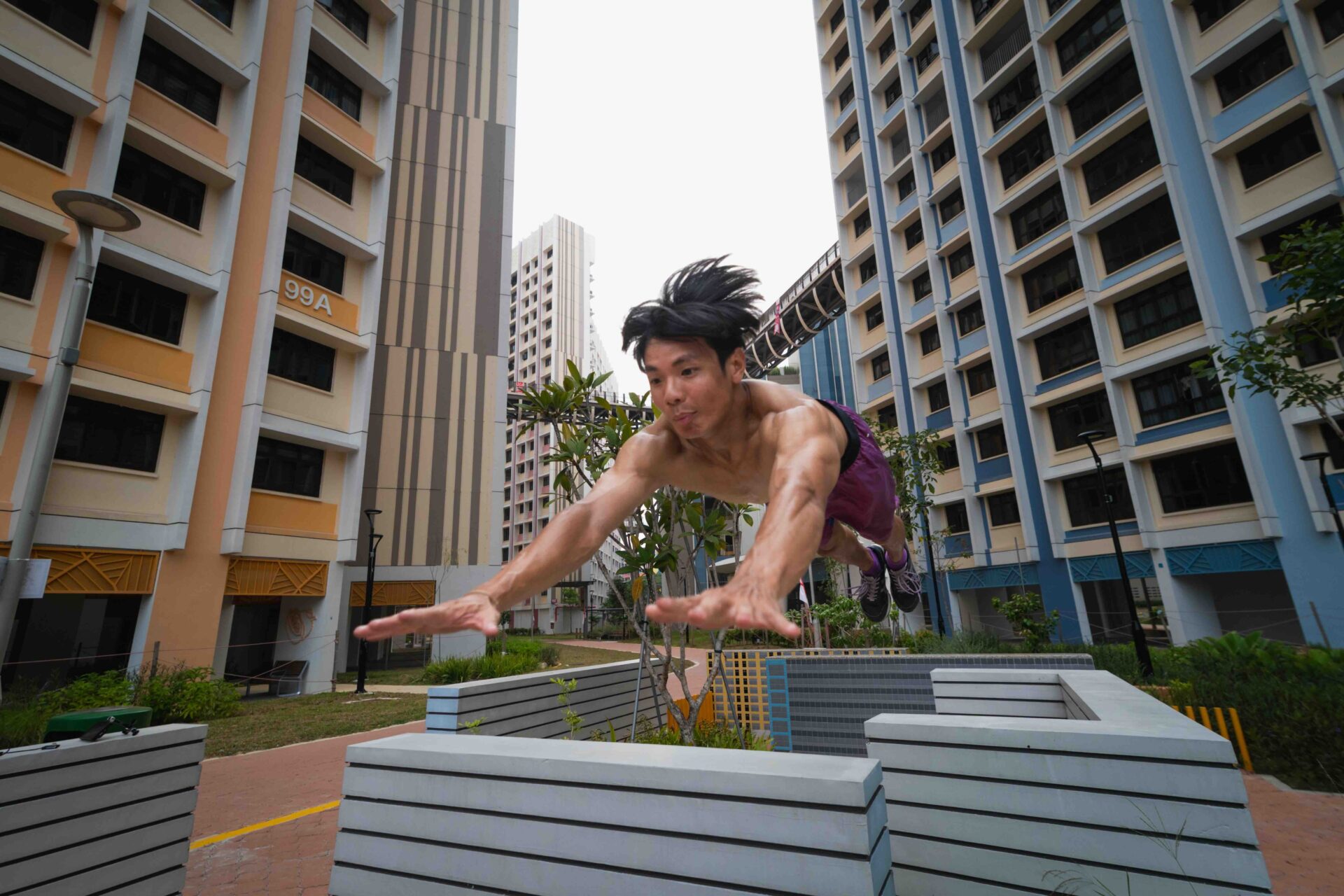
Occupation: Gym Owner-Director of Lion City Parkour, Parkour Athlete and Coach
Status: Married
Food: I try to take a good amount of protein every meal, stay away from fast food, sometimes I would do intermittent fasting and cut down carb/rice intake if I’m looking to drop some weight. I try to cook my own meals as a way to stay clean. But for the most part, I’m not super strict with my diet and still indulge in good food when I should!
Exercise: I try to minimally train two to three times a week. It used to be more frequent but I think this is a good in between for me at this current stage of my life. It would usually consist of one gym/strength training session with squats/upper body push and/or pull, and another more dynamic session where I practise my sport – parkour, flipping, Olympic weightlifting, and most recently I’ve been doing track and field, bouldering, and swimming too!
Were you active in sports when you were younger?
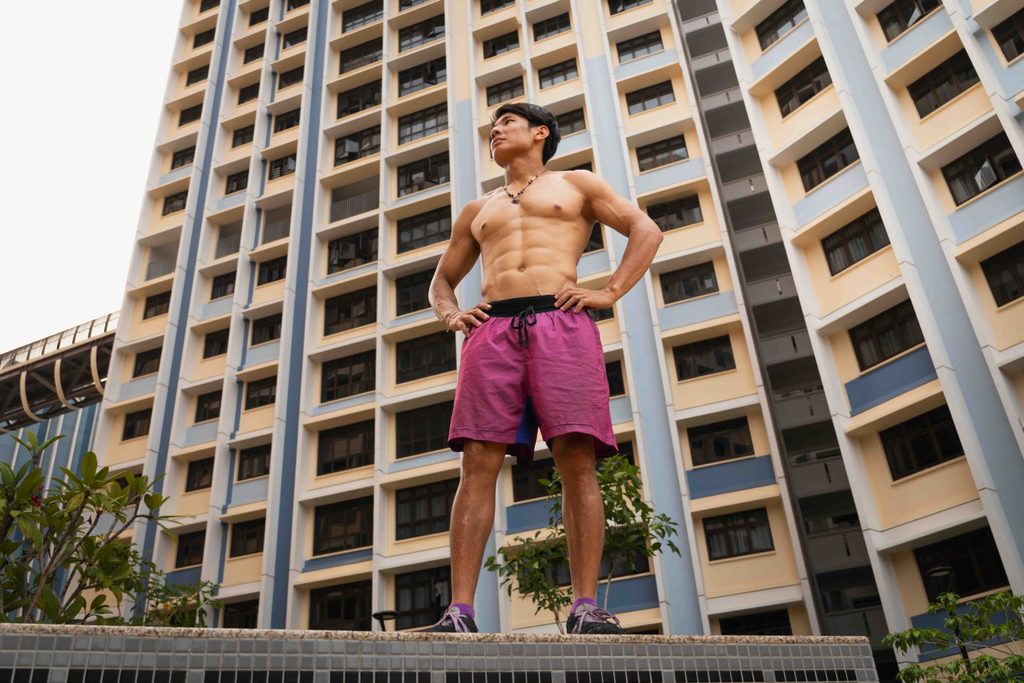
I mainly enjoyed soccer a lot as I watched the sport since a young age. I also spent a lot of time at the playground so I definitely moved around a lot.
Then I started parkour when I was 13.5 years old and I would say it’s really the first sport that I truly delved deep into, and stuck to it all the way till today. It really was the first sport that taught me everything important about life and fitness and I am really grateful for it.
Let’s talk more about your parkour journey.
I watched the French movie called Yamakasi when I was in Secondary 2 with a bunch of friends, which featured the nine original pioneers of parkour. After the movie, we immediately went downstairs to try to imitate them.
We were super inspired and mindblown about the capabilities of human body. This then became a daily after-school activity, and started to push ourselves to climb higher walls, jump further, and somehow progress just came pretty quickly by doing them more and more.
Few months later, I decided to do more research on the sport properly, and found a very small community forum back then called ‘Parkour.sg’. That’s when I met some of the most OG parkour practitioners in Singapore that definitely help guide me in my starting journey.
What were some of your most memorable parkour moments?
I started travelling overseas to meet up with the overseas communities and that’s when I realisesd parkour is a universal language. All connected via movement, we share the joys of progress and achievement together. That also made me fall in love with travelling the world, because there are so many amazing places to practise parkour around the world, and everyone in the sport really is so friendly. It really allowed me to see the world in a different light.
Slowly but surely, these little tours became parkour gathering events, and competitions started to become more popular. It inspired me to run my own events in Singapore as well, as I wanted people to travel and train with me in my hometown.
From 2015 to 2019, I hosted five years of the ‘Lion City Gathering’, which honestly was Asia’s biggest parkour event at that time! We even hosted the first few Asian Parkour Championships then, and that’s when I knew I had a knack for organising events and community building. The very first Lion City Gathering 2015 will always be my most memorable one.
As for recent memories, I also achieved podium finishes in Korea’s Way to the Top competition, which in the current age, I’d say it was also the most well-organised highest-level parkour competition I’ve been to in Asia! There’ll definitely be more to come as the Asian Parkour Championships continue to grow.
When did you decide to start Lion City Parkour?
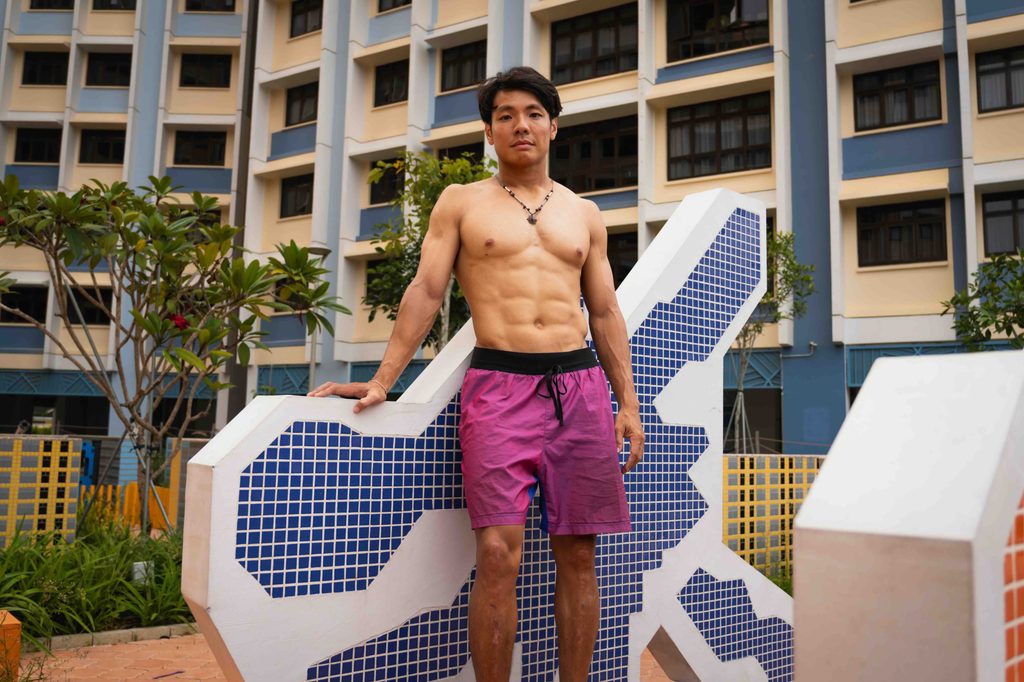
After finishing my education and travels, I needed a job. Despite a degree in Film and Television, I never truly enjoyed working in the film industry. I picked up coaching to share my knowledge in the sport to the future generations. It became something I realised I can build a career out of, especially because it is so niche, and there weren’t really many academies or gyms in Singapore we can safely learn parkour in.
Knowing I’ve already built up something from the years of online portfolio in the parkour scene and having the true passion in this sport, I took my time to really develop this. Starting out from very small classes in a friend’s ‘backyard studio’, till we became big enough to actually fund our own rental space!
What advice would you give to people thinking about starting parkour?
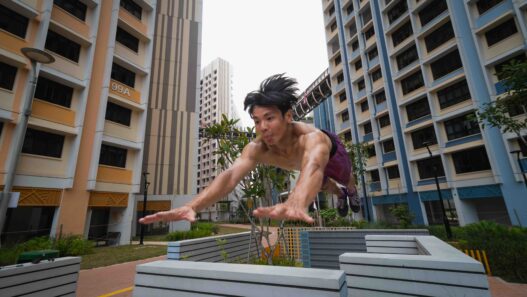
Have fun! Don’t take it so seriously. Parkour is really just moving and playing around with your body and the environment. It doesn’t need to be fancy or difficult, as long as you’re trying to figure out how to move, you’re already there. I see it as a problem solving game with your mind and body. Start small, and work your way up!
What are some of the misconceptions of parkour?
The stigma that it is dangerous, that is all about rooftop jumps, dirtying the walls, etc.
It’s easy to know only one side of parkour (which is what you see in the media, the viral reels), but if you take the time to understand the process and training behind all of it, you’d then understand the amount of work required for a practitioner to even think of attempting a higher-risk move. Besides, 99% of our training actually happens on ground level.
In my 20 years of training, I have not broken any bones or had any very serious injuries, despite some scary falls. That’s also because I’ve trained in a way to protect myself as much as possible, to take impacts and hits well, so that my joints can lasts as I still hope to train and move well till a very ripe age.
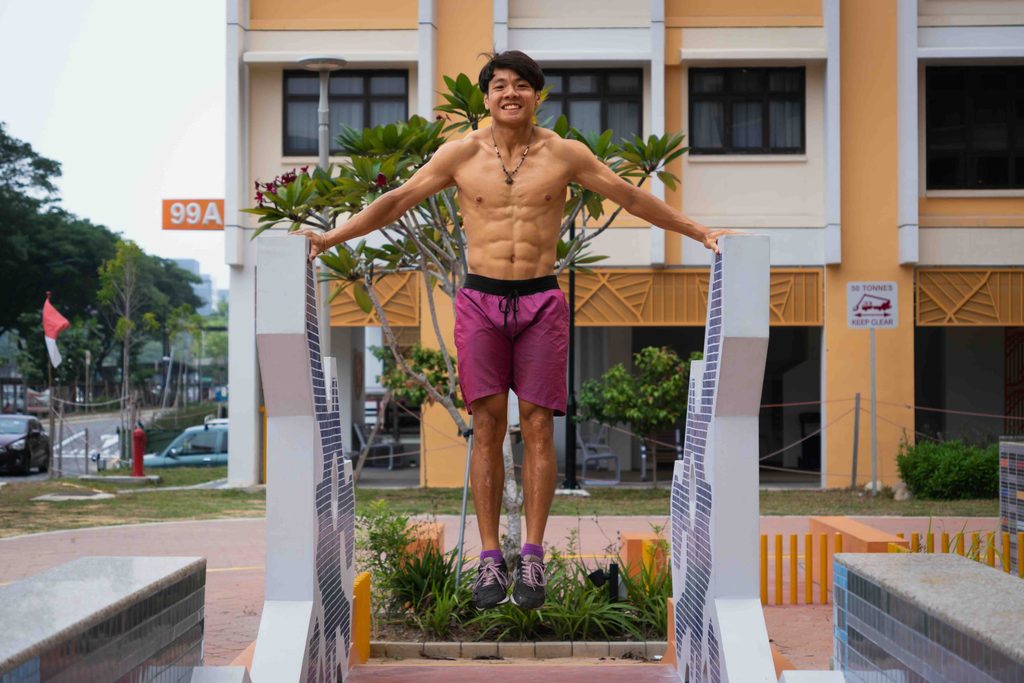
What are your goals for fitness?
Consistency. I’m not looking to be at my ‘peak’ all the time, but I do want to keep my baseline at a level where I know I am still able to perform the core essential skills without ‘losing it’ after a period of not training. That said, I do keep up the training consistency decently high, so this doesn’t become an issue naturally.
When you were younger, did you experience any incidents that made you feel insecure about yourself?
Well, yes and no. Before I started parkour, I was very unfit. Zero pull-ups, bronze for NAPFA, that sort of level. And my height, I’m not tall. Thus there were a lot of ‘disadvantages’ I had to overcome, or at least I thought they were.
After parkour, I didn’t have a huge growth spurt, but my body definitely got a lot stronger. I can also say I’ve climbed much higher walls than my taller counterparts. I never used my height or weight as ‘excuses’ to not be able to achieve something I want. I got my first gold for NAPFA in Secondary 3, and I’ve never NOT gotten gold for IPPT ever since, till today, and I hope for the rest of my life too.
Have you gone through any adversities in life that made you change how you viewed life?
There are definitely a lot of obstacles you will face through life, especially in adulthood. With the business, with relationships, with everything! I guess parkour trained me to believe that any obstacles can be overcome. Some may take a long time, some are very painful, but with enough hard and heart work, you’ll get there. It may not be the intended path you take, but eventually you’ll make peace with it.
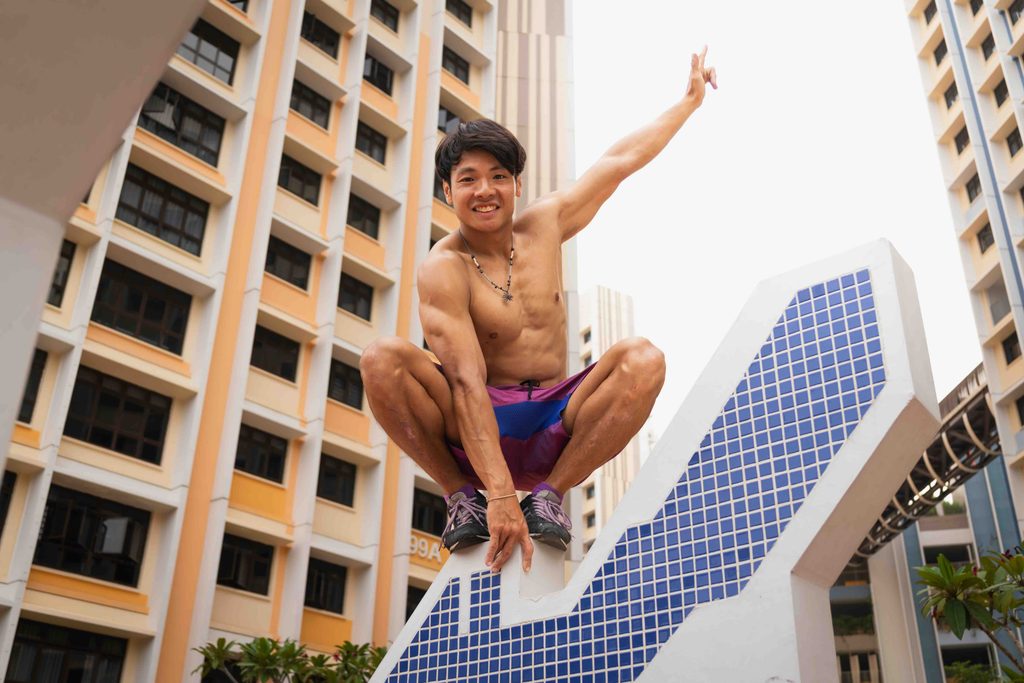
When did you feel the least confident about yourself?
There will be bouts in your life where you generally feel less secure about yourself. I do think parkour being a very physical and mentally heavy sport, you tend to focus on that a lot, and forget about the emotional, social, and other equally important aspects of life that you may be missing.
Sometimes, you can be too hyper-focused on getting good in the sport alone, and you can fall into the trap of that being your entire identity. The body and mind can only be as strong as the heart is, so sometimes it’s really okay to slow down on other aspects and attune to the other side from time to time.
Progress isn’t one-dimensional, even if you do feel ‘weaker’ or not perform as well in competitions, it doesn’t define who you are. Again, it’s just another obstacle to overcome. I pride myself in being well-rounded in my parkour and that extends out to having a well-balanced approach to the important things outside of parkour as well.
Take time off for resting (this was very hard for me!), chilling, and doing other things outside of sport can sometimes be the step you need, especially if you are already a ‘veteran’ in this.
Did you ever struggle with your body?
Not so much body image, but just overall social confidence. I don’t really see myself as a ‘social’ person just because I do really enjoy training alone and focusing on what I do best. But as I organise events, run businesses, and attend more gigs, I realise how important it is to manage everything else as well. It’s still a work in progress but I do know it’s something I shouldn’t overlook.
Are you satisfied with your body now?
Yes, it’s healthy, I am able to move the way I want to, and that’s really the biggest gift one can ask for!


